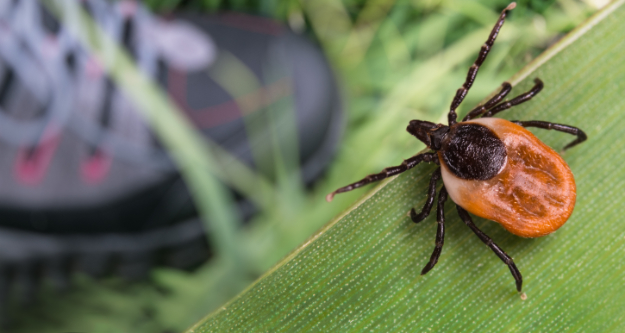
The Tick: Most Dangerous Animal in Nature
Feb 20, 2026
Jay
Nature Knowledge
The weather is warming, the trails are calling, and unseen in the grass, tick season is quietly approaching. Spring has a way of lowering your guard, winter has passed and the warming sky is slowly beckoning us to join the outdoors.
But deep in the high grass one of the most dangerous animals is starting to lurk for it’s inauspicious victims.
A Small and Silent Predator
When people think of dangerous animals in the outdoors they often picture sharp teeth, long claws and towering postures. Like wolfs, bears, snakes or even boars. But one of the most dangerous animals you can ever encounter is actually a small little insect, one that often slips trough our awareness; The Tick.
Ticks are encountered far more often than most wildlife people worry about. And even far closer to home. Along forest edges, dunes and on open fields. Places where people feel comfortable enough to sit down, take a brake and let their guard down.
Even though ticks aren’t actually insects at all. They belong to the arachnids, the same group as spiders and scorpions and like their cousins, they have eight legs and no antennae. Their biology is built for stealth and patience, not speed or aggression. This helps explain why ticks crawl deliberately, cling so firmly, and can go unnoticed for hours or even days. Very different from the buzzing, jumping insects we usually think of in the outdoors.
The Art of Waiting
The tick does not hunt in the way we usually imagine predators. It does not chase, stalk, or overpower. Instead, it relies on patience and timing. In that sense, it is closer to a trap than an animal.
Ticks operate using a strategy called "questing". They position themselves on the tips of grass blades, low bushes, or along narrow paths where animals, and people, are likely to pass. Anchoring themself with their rear legs, stretching their front legs outward and wait. They do not search, they select.
This waiting can last for days. Unlike many insects that rely on sight, ticks detect potential hosts through heat, vibration, and carbon dioxide. The warmth of a body, the rhythm of footsteps, even subtle changes in the air around them are enough to trigger action. When a host brushes past, the tick doesn’t jump or fall. It simply holds on… quietly, waiting for the right moment to strike.
Early and Closer Than You Think
In general people assume tick season begins somewhere in late spring, when the days are warm and summer plans are starting to form. In actuality ticks become active much earlier, as soon as the ground temperature rises above roughly 7°C. Especially in combination with high humidity.
A short run of mild days at the end of winter can already be enough to bring them into position, while most hikers still assume the risk hasn’t started yet. Tick activity tends to rise by late February or early March. But the calendar is a poor guide for risk analysis, temperature and ground conditions tell the real story here.
As we already said ticks are often encountered in transition zones rather then deep wilderness. Forest edges, grassy path border and low bushes are reliable tick territory. Ticks depend on traffic and take advantage of places where animals and people pass close.
They don’t jump, fly, or drop from trees, despite what is sometimes claimed. A tick gets onto you when clothing, gear, or even skin brushes past vegetation, latching on quietly and transferring with ease. Once on a host, it begins a deliberate search, crawling slowly and steadily, pausing and adjusting its path as it moves.
Ticks don’t just wander randomly over the body, neither do they aimlessly move upwards. Their movement is generally toward favourable feeding sites, which on humans are usually higher up the body.
Ticks are guided by environmental cues; warmth, moisture, and the thickness of the skin. They instinctively move toward areas where they are less likely to be disturbed and more likely to feed successfully. On humans, this usually means places like behind the knees, along waistbands, under the arms, near the groin, and behind the ears. The bite itself is rarely felt; the tick is designed for stealth and patience, not speed or aggression.
The important thing is timing. A tick does not attach immediately, this gives you a window between pickup and the bite. Awareness during and after you outing closes that window in your favour.
The Real Risk isn’t in the Bite
A tick’s bite by itself is usually harmless. Most people never feel it happen. There is no sharp sting, no tearing pain and no immediate reaction that forces your attention. From a purely physical standpoint, the bite is minor. The real danger is behind it.
Ticks are effective carriers of multiple diseases, While attached they can transmit pathogens directly in the bloodstream. Some emerging tick species have been reported capable of harbouring dozens of different pathogens, especially when they overlap with multiple host animals in an ecosystem.
The most well-known of these is Lyme disease, a bacterial infection that can affect the skin, joints, nervous system and the heart if left untreated. What makes the rist tricky is not just the illness itself, but the delay.
Symptoms don’t always appear immediately, and when they do, they are not always obvious. Fatigue, feverish feelings, joint pain, headaches or a spreading skin rash can show up days or even weeks later. Not every case presents with the class bull’s-eye rash people are told to look for. Relying on those signs alone is a poor field judgment.
Ticks don’t carry Lyme everywhere, and not every tick is infected. But risk in the outdoors is rarely about certainty, it’s about probability and exposure. The more often you move through tick habitat, the more often you host the opportunity.
There’s also a timing factor. In many cases, transmission risk increases the longer a tick remains attached. That turns awareness and routine checks into a genuine protective measure, not just a hygiene habit. Finding a tick early is not luck, it’s process.
This is why the tick earns its place among genuinely dangerous outdoor animals. Not because of what it does in the moment, but because of what it can quietly pass along while going unnoticed.
Prevention Is a Field Skill
The best way to deal with ticks is not to wait for a bite to happen. It’s about awareness, preparation and routine. Prevention is a skill, not a spray bottle or a brand. It starts the moment you enter tick habitat and continues until you’re well out of it.
When you’re moving through forests, dunes, or long grass, clothing is your first line of defence. Long sleeves, long trousers and boots that allow you to tuck pants inside reduce contact points. Smooth fabrics are harder for ticks to latch onto than rough, textured materials. Staying on established trails, keeping gear close to your body, and avoiding brushing against low vegetation all limit opportunities for ticks to climb on.
Even with the best precautions, ticks will occasionally make it onto you. This is where careful, methodical checks come in. Perform a full-body inspection immediately after leaving tick-prone areas. Don’t just check legs and ankles, a tick can be behind the knees, along the waistline, under arms, on the scalp, or behind the ears. Gear, packs and even pet companions need inspection too. The key is consistency: make it routine, make it systematic.
If you find a tick attached, removal is straightforward but requires patience. Use fine-tipped tweezers or a dedicated tick tool, grasp the tick as close to the skin as possible, and pull straight out with steady, even pressure. Do not twist, crush, or squish the tick while it’s still attached. Doing so can inject saliva or gut contents into your bloodstream, increasing the chance of disease transmission. Crushing or squishing is unnecessary, the tick’s danger comes from what it carries inside, not its immediate bite.
Sometimes a tick’s mouthparts may remain embedded after removal. This is not an emergency. Clean the area thoroughly with soap and water, disinfect, and monitor for redness or swelling. The leftover part usually works itself out over a few days. Attempting to dig it out aggressively can damage the skin, introduce infection, or make matters worse.
Conclusion
Ticks may be small and silent, but their danger is anything but trivial. They operate with patience and precision, waiting quietly on vegetation for a passing host, moving deliberately across clothing and skin, and selecting protected areas before biting. The bite itself is usually minor, almost imperceptible, but it can transmit serious diseases like Lyme, TBE, or babesiosis, illnesses that can appear days or weeks later, far from the forest or trail where the encounter occurred.
Tick season begins earlier than most expect, often with the first warm days of spring, and can persist through mild autumn periods. Their preferred habitats, forest edges, dunes, tall grass, and brush along trails, are precisely the places where hikers and adventurers naturally pause, giving these quiet predators the opportunity they rely on. Understanding when and where ticks are active is as important as recognising their behaviour once they make contact.
The real protection lies in preparation, awareness and routine. Clothing choices, staying on trails, careful inspection after exposure, and proper removal of attached ticks transform what could be a hidden threat into a manageable risk.
In the outdoors, awareness is your best field skill. Respect the environment, respect it’s inhabitants, even the tiny, quiet ones and let preparation and routine keep you safe. Ticks are part of the landscape, and with knowledge and caution, you can encounter them without letting them dictate your adventure.